
December 2022 - You are accessing an archived version of our website. This website is no longer maintained or updated. The Sustainable Development Knowledge Platform has been migrated here: https://sdgs.un.org/
December 2022 - You are accessing an archived version of our website. This website is no longer maintained or updated. The Sustainable Development Knowledge Platform has been migrated here: https://sdgs.un.org/

The establishment of the United Nations High-level Political Forum on Sustainable Development (HLPF) was mandated in 2012 by the outcome document of the United Nations Conference on Sustainable Development (Rio+20), "The Future We Want". The format and organizational aspects of the Forum are outlined in General Assembly resolution 67/290.
The Forum meets annually under the auspices of the Economic and Social Council for eight days, including a three-day ministerial segment and every four years at the level of Heads of State and Government under the auspices of the General Assembly for two days.
For the positioning of the HLPF in the UN system, please click here.
The Forum’s first meeting was held on 24 September 2013. It replaced the Commission on Sustainable Development, which had met annually since 1993.
The HLPF is the main United Nations platform on sustainable development and it has a central role in the follow-up and review of the 2030 Agenda for Sustainable Development and the Sustainable Development Goals (SDGs) at the global level. General Assembly resolutions 70/299 and 75/290 B provide further guidance on the follow-up and review of the 2030 Agenda and the SDGs.
The Forum adopts intergovernmentally negotiated political declarations.
Click here for information of HLPF 2019 under the auspices of the General Assembly – the SDG Summit, including the Political Declaration and its call on “gearing up for a decade of action and delivery for sustainable development”.
Click here for information of HLPF 2021 under the auspices of the Economic and Social Council.
As part of its follow-up and review mechanisms, the 2030 Agenda encourages member states to “conduct regular and inclusive reviews of progress at the national and sub-national levels, which are country-led and country-driven” (paragraph 79). These national reviews are expected to serve as a basis for the regular reviews by the HLPF. As stipulated in paragraph 84 of the 2030 Agenda, regular reviews by the HLPF are to be voluntary, state-led, undertaken by both developed and developing countries, and shall provide a platform for partnerships, including through the participation of major groups and other relevant stakeholders.
For more information on the Voluntary National Reviews, click here.
General Assembly resolution A/RES/70/299 decided to review the format and organizational aspects of the HLPF. For more information, click here
In accordance with General Assembly resolutions 66/288 and 67/290, the Forum, consistent with its universal intergovernmental character, shall:
General Assembly resolution A/RES/70/299 decided to review the format and organizational aspects of the HLPF. For more information on ECOSOC and HLPF reviews, click here.
As stipulated in the 2030 Agenda for Sustainable Development, the HLPF has a central role in the follow-up and review of the 2030 Agenda and its 17 SDGs at the global level, working coherently with the General Assembly, the Economic and Social Council and other relevant organs and forums.
The Forum facilitates the sharing of experiences, including successes, challenges and lessons learned and provides political leadership, guidance and recommendations for follow-up. It promotes system-wide coherence and coordination of sustainable development policies. It ensures that the 2030 Agenda remains relevant and ambitious and focuses on the assessment of progress, achievements and challenges faced by developed and developing countries as well as new and emerging issues. Effective linkages are made with the follow-up and review arrangements of all relevant United Nations conferences and processes, including on least developed countries, small island developing States and landlocked developing countries.
A central feature of the HLPF are the voluntary national reviews (VNRs) that it receives from Member States on their implementation of the 2030 Agenda and the SDGs. Regularly undertaken by both developed and developing countries, the VNRs provide a platform for partnerships, including through the participation of major groups and other relevant stakeholders.
The HLPF also undertakes annual thematic reviews of the SDGs including cross-cutting issues. As decided in General Assembly resolution 75/290 B, for the remainder of the current cycle of the high-level political forum, the themes shall be:
For the remainder of the current cycle of the high-level political forum convened under the auspices of the Economic and Social Council, the sets of Sustainable Development Goals to be reviewed in-depth shall be:
Follow up and review at the HLPF is informed by an annual progress report on the SDGs prepared by the Secretary-General of the United Nations. The most recent report is available here.. The HLPF is also informed by the Global Sustainable Development Report (GSDR), which strengthens the science-policy interface and is issued every four years (E/HLS/2016/1).
The follow up and review at the HLPF are also informed by other relevant inputs and the voluntary national reviews.
The High-level Political Forum on Sustainable Development meets:
The General Assembly in resolution 67/290 decides that all meetings of the Forum shall provide for the full and effective participation of all States Members of the United Nations and States members of specialized agencies.
For more information on the Voluntary National Reviews of member states at the HLPF, click here.
The High-level Political Forum on Sustainable Development meets:
For further information please see General Assembly resolution 67/290 on the format and organizational aspects of the Forum and resolution 70/299 on the follow-up and review of the 2030 Agenda for Sustainable Development at the global level.
For the positioning of the HLPF in the UN system, please click here.
The General Assembly has reviewed the functions of the Economic and Social Council periodically since its creation. The Council has adapted its functions over time to correspond to the dynamic international development landscape. In 2018, General Assembly resolution 72/305 on the implementation of the GA resolution 68/1 on ECOSOC strengthening addressed a wide range of issues, including revisiting the ECOSOC cycle, and the Council’s oversight and coordination of its subsidiary bodies. The General Assembly also decided that the arrangements contained in that resolution and its annex would be reviewed at the 74th session of the GA and at subsequent review cycles in conjunction with the review process of the HLPF.
On the High-level Political Forum on Sustainable Development (HLPF), the General Assembly decided in 2016 in its resolution 70/299 to review progress in implementing resolution 70/299 and resolution 67/290 on the format and organizational aspects of the HLPF at its 74th session. The review was to benefit from lessons learned in the first four-year cycle of the forum, including the SDG Summit in September 2019, as well as from other processes under the GA and ECOSOC related to the follow-up and review of the implementation of the 2030 Agenda for Sustainable Development.
During the 74th session of the General Assembly, on 13 January 2020 the President of the GA appointed the Permanent Representative of Benin and the Permanent Representative of Georgia to facilitate the intergovernmental negotiations related to the implementation of resolution 72/305 on ECOSOC strengthening and the HLPF resolutions 67/290 and 70/299.
The General Assembly then adopted, in August 2020, resolution 74/298 on the review of the implementation of General Assembly resolution 67/290 on the high-level political forum on sustainable development, resolution 70/299 on the follow-up and review of the 2030 Agenda for Sustainable Development at the global level and resolution 72/305 on the strengthening of the Economic and Social Council. Due to the limits to the negotiation process resulting from the COVID-19 pandemic. The resolution deferred much of the review of ECOSOC and HLPF to the following session of the General Assembly.
During the 75th session of the General Assembly, on 5 November 2020, the President of the GA appointed the Permanent Representative of Austria and the Permanent Representative of Senegal to facilitate the intergovernmental negotiations related to the ECOSOC and HLPF review process.
The General Assembly further adopted, on 25 June 2021, resolution 75/290 A on the Review of the implementation of GA resolution 72/305 on the strengthening of ECOSOC and resolution 75/290 B on the Review of the implementation of GA resolutions 67/290 on the format and organizational aspects of the HLPF and 70/299 on the follow-up and review of the 2030 Agenda for Sustainable Development at the global level:
75/290 A - Economic and Social Council [ العربية | 中文 | English | Français | Pусский | Español ]
75/290 B - High-level political forum on sustainable development [ العربية | 中文 | English | Français | Pусский | Español ]
Non-papers for the Consultations:
Secretariat’s Issue Briefs on ECOSOC’s work and roles
Other Relevant Background Documents:
The organizations of the United Nations system, including the Bretton Woods institutions and other relevant intergovernmental organizations, including the World Trade Organization, are invited to contribute within their respective mandates to the discussions of the Forum.
For information of inputs of the UN system and other intergovernmental bodies and forums to the HLPF, click here
Member States have stressed the need for the HLPF to promote transparency and implementation by further enhancing the consultative role and participation of the major groups and other relevant stakeholders at the international level in order to make better use of their expertise, while retaining the intergovernmental nature of discussions. The major groups and other stakeholders include non-governmental and non-profit organisations, business and industry, and local authorities, among others. In accordance with General Assembly resolution 67/290, the Forum is open to the major groups, other relevant stakeholders and entities having received a standing invitation to participate as observers in the General Assembly, building on arrangements and practices observed by the Commission on Sustainable Development.
While retaining the intergovernmental character of the forum, the representatives of the major groups and other relevant stakeholders shall be allowed:
Note: Major Groups and other Stakeholders allow for a structured engagement and contribution of civil society to the intergovernmental processes on sustainable development. They are self coordinated and independent from the UN Secretariat. Representatives of the Major Groups are therefore NOT representatives or staff of the United Nations, nor are they authorized to enter into business arrangements on behalf of the United Nations, or use the United Nations’ name or logo for endorsement of an activity. |
The Office for Intergovernmental Support and Coordination for Sustainable Development of the United Nations Department of Economic and Social Affairs serves as the Secretariat of the High-level Political Forum on Sustainable Development.
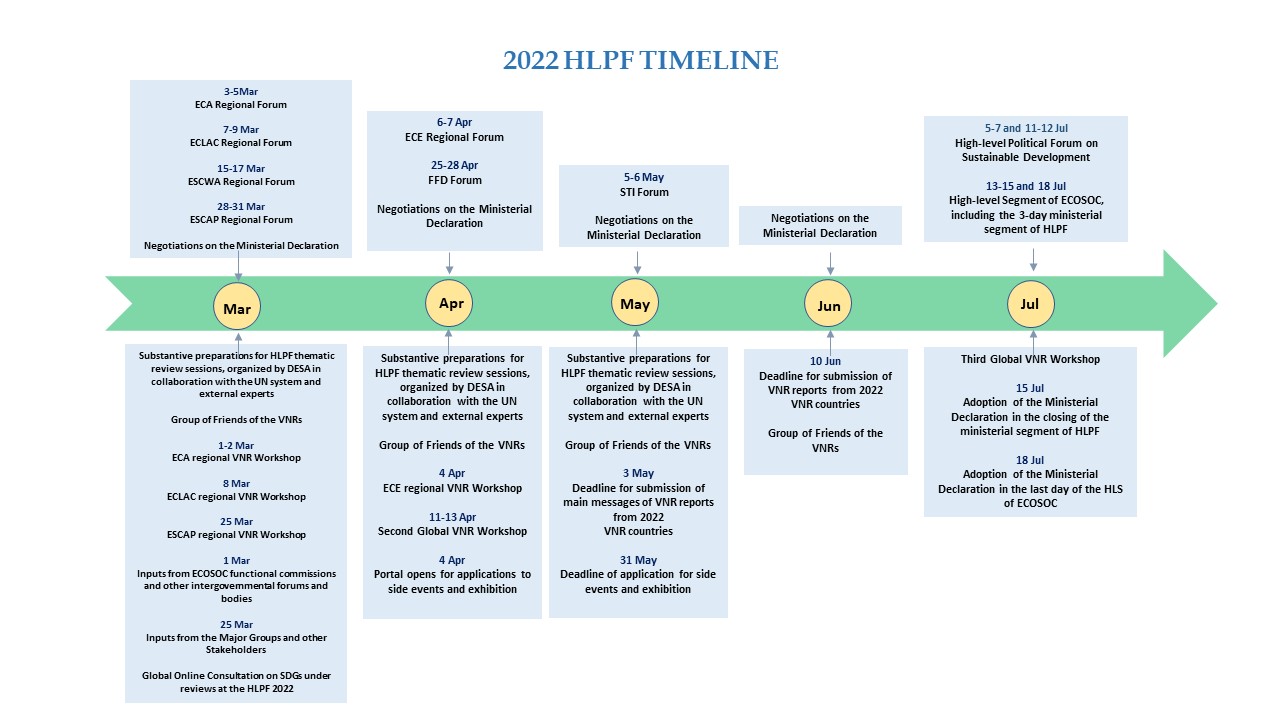
The meeting of the HLPF in 2022 will be held from Tuesday, 5 July, to Thursday, 7 July, and from Monday, 11 July, to Friday, 15 July 2022, under the auspices of the Economic and Social Council. This includes the three-day ministerial segment of the forum from Wednesday, 13 July, to Friday, 15 July 2022. The high-level segment of the Council will conclude with a final day on Monday, 18 July 2022.
The theme for the 2022 HLPF is “Building back better from the coronavirus disease (COVID-19) while advancing the full implementation of the 2030 Agenda for Sustainable Development”.
As the world is struggling to recover from COVID-19 amidst continuing crises, the HLPF will reflect on how recovery policies can reverse the negative impacts of the pandemic on the SDGs and move countries on to a path to realize the vision of the 2030 Agenda.
The HLPF will also review in-depth Sustainable Development Goals 4 on quality education, 5 on gender equality, 14 on life below water, 15 on life on land, and 17 on partnerships for the Goals. It will take into account the different impacts of the COVID-19 pandemic across all Sustainable Development Goals and the integrated, indivisible and interlinked nature of the Goals.
Detailed programme (forthcoming)
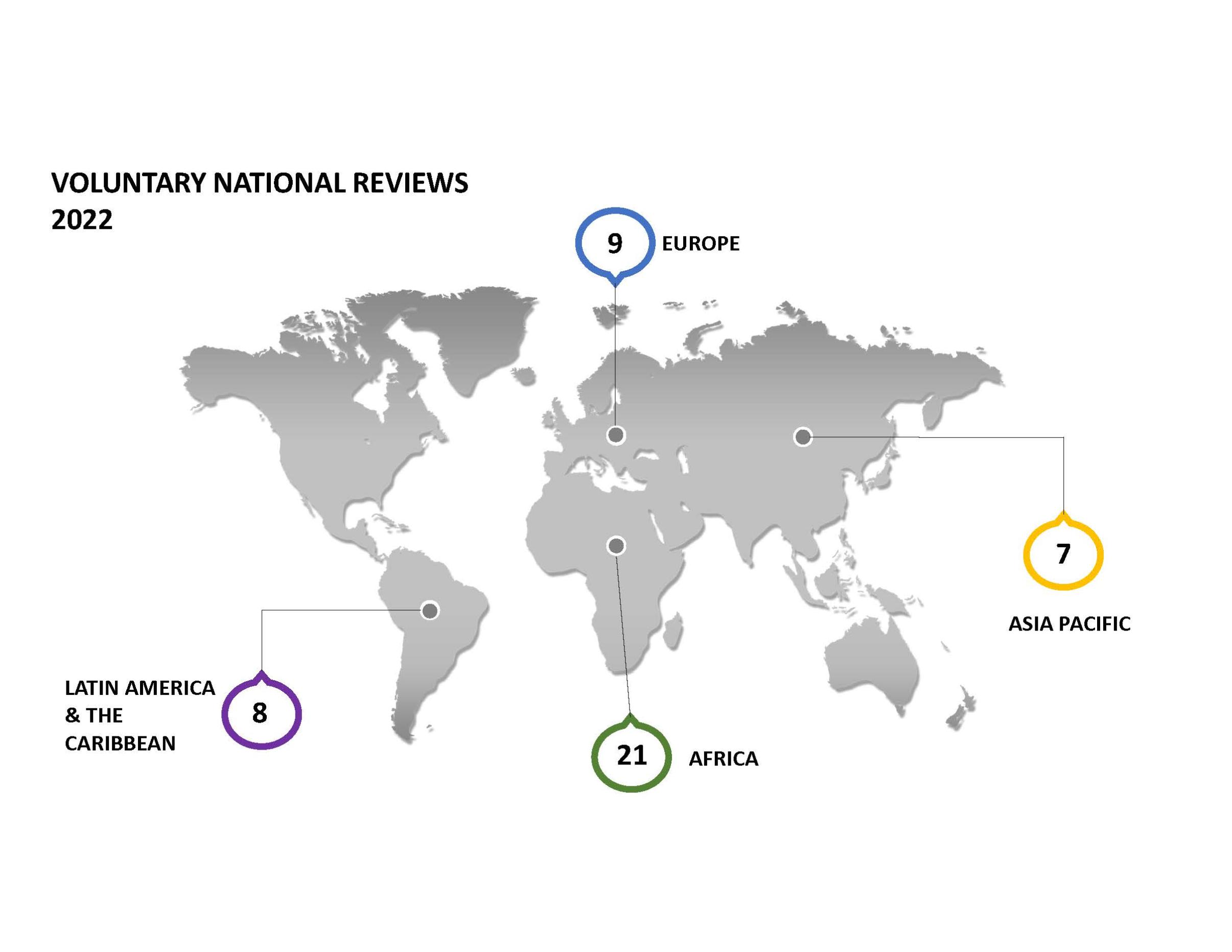
45 countries will carry out voluntary national reviews (VNRs) of their implementation of the 2030 Agenda for Sustainable Development. For more details, please click here.
The HLPF has been prepared by the Regional Forums on Sustainable Development convened by the Regional Commissions in March-April 2022. The regional forums assessed progress and exchange knowledge, good practices and policy solutions on how to support the implementation of the 2030 Agenda as an integral part of the recovery from COVID-19.
UN system and other intergovernmental bodies and forums have also provided inputs to the thematic reviews of the 2022 HLPF. Please click here to access these inputs to the HLPF.
UNDESA has been organizing substantive preparations for the thematic reviews of the 2022 HLPF 2022 together with relevant UN system partners. For more details, please visit Expert Group Meetings on 2022 HLPF Thematic Review.
The HLPF will adopt the Ministerial Declaration as the outcome of its session. The President of ECOSOC will also prepare a summary to capture the key messages of the discussions.
Other events, including Side Events, VNR Labs, Special Events, and Exhibition are being organized on the margins of the 2022 HLPF. For information, please click here.
All stakeholders were invited to submit inputs through a global online stakeholder consultation on the SDGs under review during the 2022 HLPF and interlinkages with other SDGs.
Side Events and Exhibitions provide great opportunities to discuss themes and SDGs under review at the HLPF, deepen the discussion on VNRs, identify new issues, listen to all voices, and help spread greater awareness of the 2030 Agenda and the SDGs in general at all levels.
Side Events and Exhibitions will be scheduled on the margins of the 2022 HLPF under the auspices of ECOSOC and sponsored by Member States, the UN system, intergovernmental organizations, the Major Groups and other Stakeholders and accredited Non-governmental Organizations including those with special consultative status.
Proposed side events and exhibitions should be closely related to the work of the High-level Political Forum on Sustainable Development (HLPF) and should have as a main focus the theme for the 2022 meeting under the auspices of ECOSOC "Building back better from the coronavirus disease (COVID-19) while advancing the full implementation of the 2030 Agenda for Sustainable Development". The HLPF in 2022 will also review in-depth SDG 4 on quality education, SDG 5 on gender equality, SDG 14 on life below water, SDG 15 on life on land, and SDG 17 on partnerships for the Goals.
In view of the current situation regarding Covid-19, and due to the lifting of restrictions at UN Headquarters in New York, some Side-events and Exhibitions are now possible to be held in-person. Priority will be given to countries presenting their Voluntary National Reviews at the High-level Political Forum on Sustainable Development this year and events with Ministerial participation.
The deadline to submit an application has passed and the portal closed automatically on Tuesday, 31 May 2022.
The HLPF Secretariat will now be reviewing the 386 submissions and we will contact ALL organizers on the status of their side-event by mid-June.
Since 2018, the VNR Labs have become a much-appreciated feature of the HLPF. The Labs will again provide an informal platform for sharing experience and for reflection on the VNR process, as additional opportunities for informed discussion. The theme for the 2022 VNR Labs is “Sustaining Momentum for Achieving the SDGs.” A programme of VNR Labs is being developed and will be posted on this page by mid-June.
Click here for information on the VNR labs in 2021.